

Table of Contents
- Protective Apparel for Off-Road Racers: Suits, Armor, and Helmets
- Off-Road Recovery Gear Essentials: Winches, Ropes, and Traction Boards
- Navigation Tools for Rally Racing: GPS, Roadbooks, and Communication
- Footwear, Hydration, and Ergonomics for Long-Distance Fatigue
- Regulatory Compliance: SFI and FIA Safety Standards for 2026
- Rally-Specific Logistics: Packing, Tools, and Emergency Kits
- Conclusion: Building Your Race-Ready Kit
- Frequently Asked Questions
Last Updated: September 14, 2026
Protective Apparel for Off-Road Racers: Suits, Armor, and Helmets
The global rally sport riding gear market hit USD 1.6 billion in 2025 and is projected to reach USD 3.3 billion at a 7.8% compound annual growth rate, according to global rally riding gear market analysis. That growth reflects a hard truth: gear for off road rally is not a fashion choice. It is the difference between finishing a stage and being airlifted off it. At Rx4Adventure, we support our ongoing journey in the Rebelle Rally, where heat, dust, and fatigue expose every weak seam.
Protective apparel is the layer between you and a roll cage, a rock, or a fire. It splits into three jobs: burn protection, impact protection, and thermal management.
Fire Suits and Base Layers
A fire suit is a single- or multi-layer garment made from flame-resistant material that shields a driver from fire and heat during a crash or mechanical failure. Underneath it, moisture-wicking base layers pull sweat off your skin so the suit does not turn into a sauna.
Choose synthetic, moisture-wicking fabrics over cotton. [Our Men's Hooded Performance Long Sleeve Shirt](https://rx4adventure.myshopify.com/products/rx4adventure-men-s-hooded-performance-long-sleeve-shirt) uses 100% recycled poly interlock with UPF 44+ and odor resistance, which is exactly what you want under a fire suit when you cannot change for 12 hours.

Helmets, Goggles, and Neck Braces
A ventilated helmet with a proper head and neck restraint is non-negotiable. Goggles need anti-fog lenses and a snug seal against dust; a neck brace distributes impact force away from the cervical spine. For rally raid conditions, prioritize ventilation over weight savings. A fogged lens at speed is a crash waiting to happen.
Off-Road Recovery Gear Essentials: Winches, Ropes, and Traction Boards
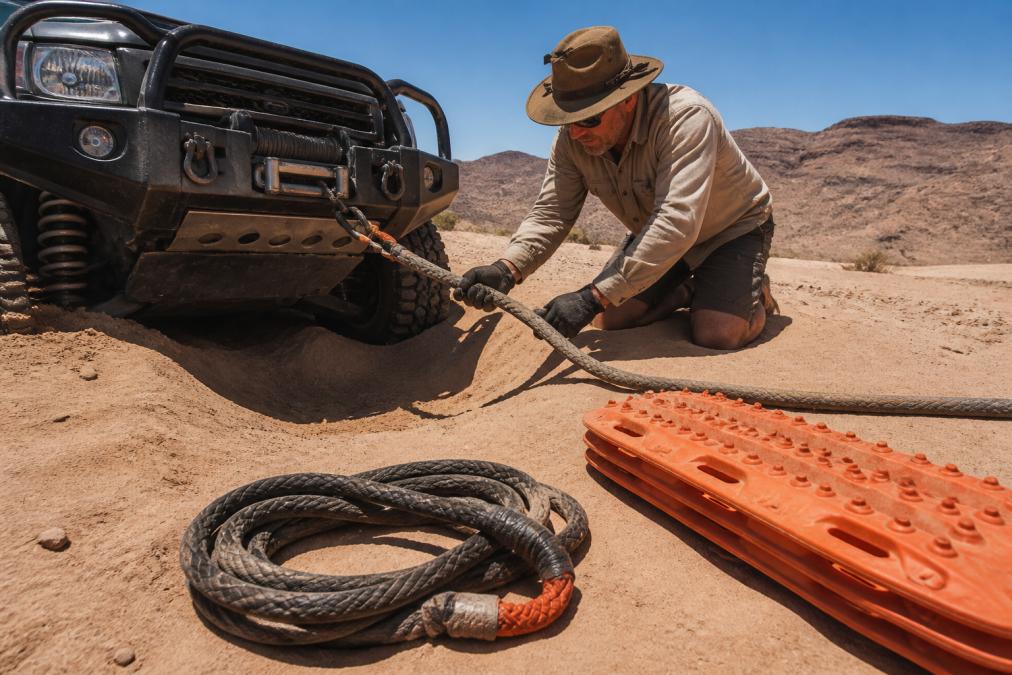
When you are stuck 60 kilometers from the nearest service point, recovery gear becomes survival equipment. The essentials are a winch, kinetic rope, soft shackles, and traction boards. Industry data shows a clear shift toward brushless technology in competition winches and recovery tools, improving efficiency and reliability under load (Superior Engineering recovery equipment trends).
Kinetic Ropes, Soft Shackles, and Winch Setup
A kinetic rope is a stretchable recovery line that stores energy and releases it to pull a stuck vehicle free without the violent shock of a static strap. Soft shackles replace metal D-rings and reduce the risk of lethal recoil if something snaps.
Here is the recovery sequence that works:
- Identify a solid anchor point rated for at least twice your vehicle's weight
- Attach the soft shackle to the recovery point, never to a hitch ball
- Lay out the kinetic rope with no kinks and clear the area of bystanders
- Build tension slowly, then let the rope's stretch do the work
- Reset and repeat rather than yanking at full throttle
Navigation Tools for Rally Racing: GPS, Roadbooks, and Communication
Navigation tools for rally racing are the equipment that gets you to the finish line when there are no signs, no cell service, and no second chances. A rally computer, a GPS unit, a physical roadbook, and a satellite communicator form the core stack. Redundancy is the rule: if one system fails, you need a backup that does not depend on the same power source or signal.
The Rebelle Rally, a women-only, no-GPS off-road event, proved how far specialized navigation and endurance gear can push competitors (Car and Driver coverage of the Rebelle Rally). Competitors navigate by roadbook and compass alone. That format forces you to trust paper and preparation, not just a screen.
For adventure riding and cross-country rally, carry a handheld GPS with preloaded tracks, a backup paper map, and an emergency communication device. A satellite messenger is not optional when your route leaves coverage.
Footwear, Hydration, and Ergonomics for Long-Distance Fatigue
Footwear: Traction, Ankle Support, and Pedal Feel
Footwear has to solve three conflicting problems at once. It needs enough tread and ankle structure to walk a rocky service road, enough heat resistance to survive radiant heat from a floor pan, and enough pedal feel to modulate brakes and throttle by millimeters. A common pattern among endurance racers is to chase weight reduction, and some argue for lightweight trail shoes over heavy boots for specific segments (Endless Mountains Adventure Race gear philosophy). My take for rally raid: prioritize a stiff, heat-resistant sole and ankle protection over grams saved. A rolled ankle during a tire change costs more time than the weight ever saves.
What to look for:
- Thin, heat-resistant sole with a defined heel so your foot does not slide off the pedal under braking
- Ankle collar that clears the fire suit cuff without bunching
- Lacing or strap system you can operate with gloves on during a service stop
- Breathability, a waterproof membrane that traps sweat is worse than a vented shoe in desert heat
Hydration as a Performance System
Hydration is a performance system, not an afterthought. Carry a hands-free hydration system and a durable bottle within reach. [The Rx4Adventure stainless steel water bottle](https://rx4adventure.myshopify.com/products/stainless-steel-water-bottle) keeps liquid cold for hours in desert heat, and the double-walled design means it will not sweat onto your electronics.

A practical setup for a long stage:
- Bladder in a pack or seat-back sleeve for hands-free sipping while belted in
- Rigid bottle within arm's reach for the co-driver or for service stops
- Electrolyte tabs or powder, plain water alone does not replace sodium lost through sweat
- Refill plan tied to your fuel and service stops, not to how thirsty you feel
Ergonomics: Where Fatigue Actually Starts
The gear choices that matter most for fatigue are the ones you wear against your body for the whole stage. A neck brace redistributes impact load, but a poorly fitted one also restricts head rotation, which increases neck strain over hours. A hydration pack that sits high on the shoulders pulls on the trapezius; one that sits low on the lumbar can dig into a seat. The fix is not a single product, it is fitting each piece so it does not fight the others.
| Fatigue Factor | What Goes Wrong | Gear Fix |
|---|---|---|
| Dehydration | Reaction time drops, cramping | Hands-free hydration system plus electrolytes |
| Poor seating | Back and hip pain | Lumbar support, seat insert, harness fit check |
| Foot fatigue | Weak pedal control | Stiff-sole driving boots with defined heel |
| Heat stress | Cognitive decline | Moisture-wicking base layers, vented helmet |
| Neck strain | Reduced head rotation, tension headaches | Correctly sized neck brace, lightweight helmet |
Regulatory Compliance: SFI and FIA Safety Standards for 2026
Regulatory compliance is where casual off-roaders and serious competitors separate. The 2026 American Off-Road Racing Championship rulebook mandates that all participants in car, truck, and UTV categories use SFI- or FIA-approved safety gear, including fire suits, helmets, head and neck restraints, and gloves (2026 American Off-Road Racing Championship rulebook).
That means every piece of safety apparel needs a visible certification label. Fire suits, helmets, and restraints carry SFI or FIA tags. If a product lacks the tag, it does not count, no matter how good it looks.
Rally-Specific Logistics: Packing, Tools, and Emergency Kits
Most gear lists assume a single day and a single vehicle. A multi-day rally raid is a different problem: you are managing weight, space, and access across a support vehicle, a service crew, and whatever the race car or bike actually carries on stage. Getting that split wrong means carrying 20 kilograms you never touch, or leaving the one tool you need back at the bivouac.
The Three-Tier Packing Model
Think of your gear in three tiers, and pack each tier separately.
Tier 1, On the vehicle, on stage. Only what you need to keep moving or survive if you stop. This is the lightest tier and the one you should rehearse accessing with gloves on.
- Tire repair kit with plugs, patches, and a compact compressor
- Basic tool roll: sockets, wrenches, pliers, zip ties, safety wire
- First-aid pouch and a fire extinguisher mounted within reach
- Spare fluids in sealed containers
- Satellite communicator and a backup paper map
Tier 2, In the support vehicle. Everything that gets you back on stage after a stop, but that you do not want bouncing around the cabin.
- Full socket set and torque wrench
- Spare belts, hoses, and fasteners
- Spare helmet visor or goggles, spare gloves
- Additional hydration and food for the crew
- Weather-proofing: dry bags for electronics, documents, and spare clothing
Tier 3, At the bivouac or service park. Bulk spares, tires, and comfort items that only matter between stages.
- Spare wheels and tires
- Camp and sleep system
- Charging station and power bank for navigation devices
- Spare fire suit or base layers if you have them
Tools That Earn Their Weight
A multitool and a socket set cover most trailside repairs, but the tools that actually save stages are the ones matched to your specific vehicle. Before the race, walk the car or bike and identify every fastener you can realistically reach on the side of the road, then build a tool roll around those. Zip ties, safety wire, and self-fusing silicone tape fix more than you would expect and weigh almost nothing.
Emergency Kits and Weather-Proofing
An emergency kit is not a first-aid box you never open. It is a first-aid pouch, a fire extinguisher, flares or a warning triangle, and a way to signal for help when there is no cell service. Weather-proofing matters just as much: electronics and documents go in dry bags, and anything you might need in the dark gets a headlamp or a marker so you can find it without unpacking the whole vehicle.
[The Rx4Adventure trucker hat](https://rx4adventure.myshopify.com/products/rx4adventure-trucker-hat) is a small but real example of smart packing: a mesh-back, unstructured cap that packs flat, breathes in heat, and stays put under a helmet strap during service stops. Small gear that does not fight you matters over 2,000 kilometers.

Conclusion: Building Your Race-Ready Kit
Building a race-ready kit is a process, not a purchase. Start with certified safety apparel, add recovery gear you have actually practiced with, and layer in navigation redundancy and fatigue management.
Rx4Adventure offers a curated selection of coffee collections and branded gear designed for those who embrace the spirit of exploration. Founded by medical professionals with a passion for off-road travel, our products support our ongoing journey in the Rebelle Rally. We serve adventurers who value resilience, teamwork, and the thrill of discovering what lies off the beaten path.
Get started with Rx4Adventure and build a kit that gets you to the finish line.
Frequently Asked Questions
What are the essential safety gear requirements for off-road rally racing?
Required items include fire suits, helmets, head and neck restraints, and gloves. Always check your specific sanctioning body's current regulations before buying, because requirements vary by class and event.
How does off-road rally gear differ from standard trail riding equipment?
Rally gear is built for sustained high-speed abuse over long distances. A trail-riding helmet may be fine for a weekend, but a ventilated helmet with FIA certification handles hours of dust and heat. Recovery gear shifts from occasional-use straps to kinetic ropes and soft shackles rated for repeated heavy pulls. Navigation moves from a phone mount to a dedicated GPS and roadbook system. Durability, weight, and regulatory compliance all scale up for race conditions.
What navigation tools are critical for competitive off-road rallies?
A dedicated GPS unit with rally-specific mapping, a roadbook holder, and a tripmeter are the core navigation tools for rally racing. Many events, like the Rebelle Rally, prohibit GPS entirely and require map-and-compass navigation, so practice those skills. Carry a backup handheld GPS and a satellite communicator for emergency communication. Paper roadbooks and a reliable compass remain essential when electronics fail in remote terrain.
How do you choose the right recovery gear for desert rally conditions?
Start with a kinetic rope rated for at least 1.5 times your vehicle's weight, plus soft shackles instead of metal D-rings to reduce injury risk if a line breaks. Add traction boards for sand and loose gravel, and a winch with a synthetic line for heavier pulls. Match every component's working load limit to your rig, and practice recovery before race day.
What should be included in an off-road rally emergency kit?
A rally emergency kit should include a comprehensive first-aid kit, a tire repair kit with plugs and a compressor, a multitool, zip ties, duct tape, and spare fuses. Carry at least 2 gallons of water per person, high-energy snacks, and a satellite communicator. Pack fire extinguishers rated for fuel and electrical fires, plus a reflective vest and warning triangles. For remote stages, add a personal locator beacon and a basic shelter.
What gear do you need for long-distance off-road endurance events?
Long-distance events demand lightweight, durable gear. Start with moisture-wicking base layers and a ventilated helmet to manage heat. Ergonomic seating, a kidney belt, and supportive footwear reduce fatigue over hundreds of miles. Carry a hydration system with at least 2 liters, plus electrolytes. For navigation, a roadbook and tripmeter are mandatory in many events.